The Core Functions of NIST CSF: Identify
TRENDING
PUBLISHED on
04
February
2026


In this blog, we explore the Identify Function of the NIST CSF and how it helps organisations build a clear understanding of their assets, risks and areas for improvement. We outline the Function’s requirements and what you need to do to meet them, such as the key activities involved in effective asset management, assessing and prioritising cyber risks, and how areas for improvement can be identified. We also include practical examples of how organisations can apply these activities in day-to-day operations to make the Identify Function more tangible.
Building an effective cyber security programme requires a clear understanding of what an organisation needs to protect, the risks that threaten those assets, and the measures necessary to address those risks. Within the National Institute of Standards and Technology Cybersecurity Framework (NIST CSF), the Identify Function provides this foundation, enabling organisations to develop a comprehensive view of their cyber security risks and manage these appropriately.
Identify is the second of the CSF’s six functions; to learn about the first, read our blog on The Core Functions of NIST CSF: Govern.
The Identify Function of NIST CSF is focused on ensuring that the cyber security risks your organisation has identified are properly understood and managed. This involves effectively managing your assets, assessing and prioritising risk and, where needed, improving your approach to cyber security risk management.
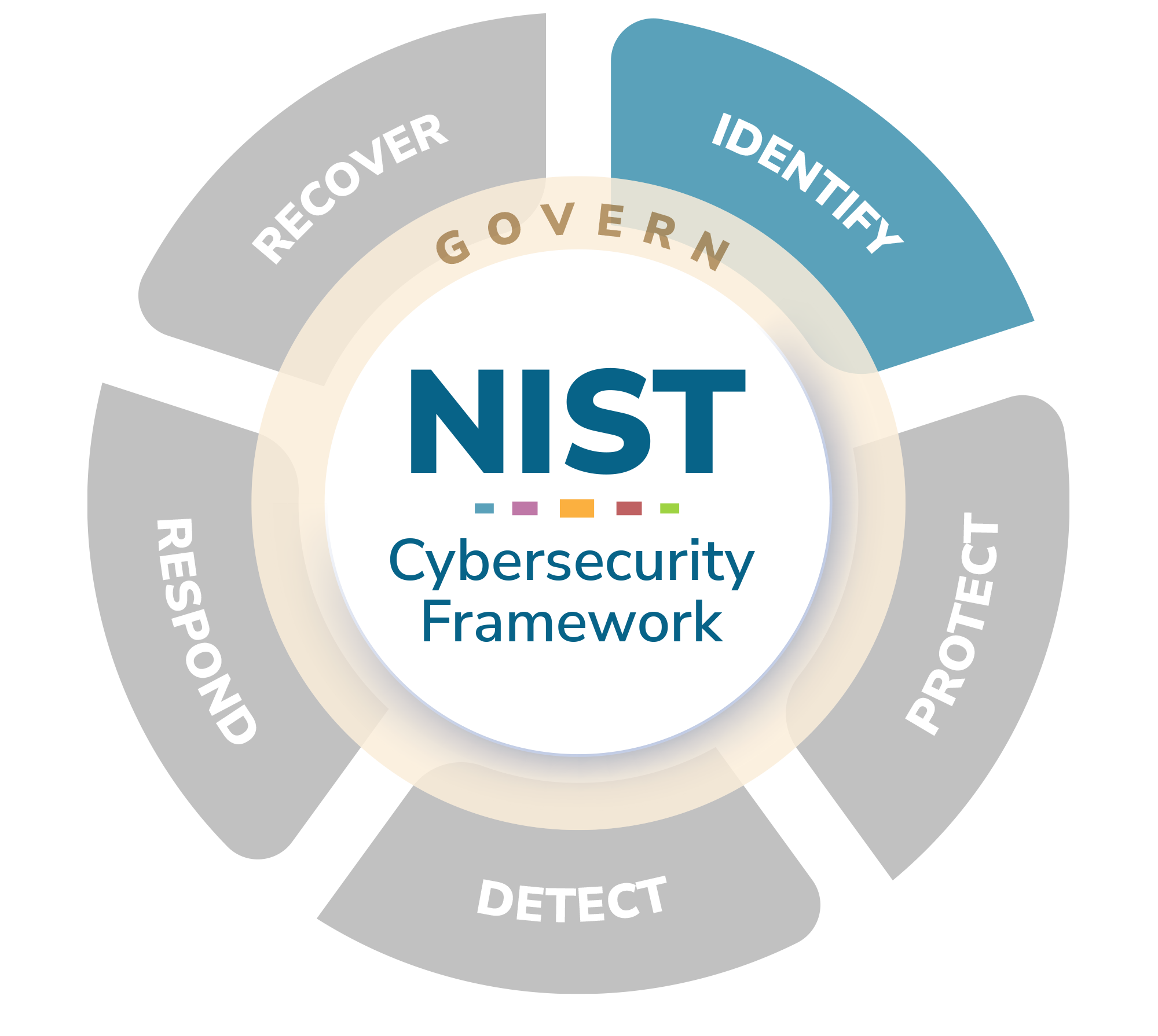
The Identify Function comprises three Categories, which we will explore below.
The Asset Management Category focuses on building a clear picture of the assets that enable your organisation to achieve its business purposes, as well as managing these assets in line with your organisation’s risk approach and business objectives throughout their entire lifecycle. Additionally, this Category requires you to prioritise assets based on their classification, criticality to the business, the supporting resources available, and their overall impact on your organisation’s mission.
When managing your assets, you need to maintain asset inventories to document them; the assets you need to document include:
As part of the measures taken to protect your data, you also need to clarify the communication methods that you’ve authorised for both internal and external communications by producing visual representations of your data flows. This includes displaying where your data comes from, where it goes, how it gets there, any changes made to it during transit, and how it is stored.
Many organisations now use automated discovery tools that scan networks and cloud platforms to populate asset inventories, ensuring they stay up to date without relying on manual input. A common practical step is mapping the data flow for a single high-risk process first, such as payroll or customer onboarding, then using that template to map other processes across the organisation.
This Category is about developing a thorough understanding of the cyber security risks facing your organisation, your assets, and your stakeholders. This means identifying and recording internal and external threats relevant to your organisation and, in your subsequent risk assessment, evaluating the impact and likelihood of these vulnerabilities being exploited by a related threat.
Such threats, vulnerabilities, impact and likelihood scorings will form the basis of your inherent risk rating and allow you to determine your risk responses. Such responses need to be planned and prioritised in advance, tracked on an ongoing basis, and communicated to the appropriate individuals (such as management, or others involved in the risk response).
Alongside assessing risks, you must also identify, validate and record any vulnerabilities in your assets themselves, and receive, analyse and react to these vulnerabilities in line with documented processes such as a vulnerability disclosure process.
If changes or exceptions need to be made to your cyber security risk strategy, these need to be formally managed by assessing and documenting the impact of the change or exception, and tracking them on an ongoing basis.
To stay ahead of emerging threats, your organisation must gather and analyse information about existing information security threats in order to produce threat intelligence. Such information must come from information security forums and other reputable security sources (such as government security agencies, newsletters, etc.). These sources can provide you with up-to-date information about the types of threats that exist, the technologies, tactics and actors associated with them, whether the intelligence is relevant to them and to what degree.
Finally, to reduce the likelihood of an incident relating to the authenticity or integrity of hardware and software used, your organisation needs to assess these items before they are acquired or used. Likewise, third-party suppliers providing critical products and services must be formally assessed prior to being engaged by your organisation.
A practical way to operationalise this is to conduct brief, quarterly threat modelling workshops with IT and business owners. These sessions review recent threat intelligence and map it to real business processes. Another example is embedding third party risk assessments into procurement workflows so that no new supplier is approved without a cyber risk review.
The Improvement Category requires you to proactively identify improvements to your cyber security risk management strategy across all of the NIST CSF Functions. This includes identifying areas for improvement by:
You are also required to produce incident response plans and other cybersecurity plans (where necessary) to prepare for incidents affecting your business operations. Such plans need to be communicated to users, kept up-to-date, and improved where necessary.
Many organisations run short, scenario based tabletop exercises periodically (e.g., every six months) with their executive teams. These sessions test real processes, such as how ransomware would be escalated, who decides to take systems offline and how customers would be informed. A simple improvement activity might involve updating the incident response plan based on lessons learned from these exercises.
The Identify Function of the NIST CSF plays a central role in helping organisations build a clear, accurate picture of their cybersecurity risk landscape. By understanding your risks whilst prioritising your assets and suppliers, your organisation will be enabled to respond to those risks in a way that is appropriate and proportionate to the risks themselves. Together, the Asset Management, Risk Assessment and Improvement Categories ensure that security decisions are informed, prioritised, and aligned with business needs.
With 2 decades of experience helping organisations align with major cyber and information security standards, legislation, and frameworks, URM is the ideal partner to provide NIST CSF consultancy services to support your organisation’s conformance to the CSF. Our large team of experienced NIST CSF consultants can offer your organisation a range of consultancy services to help you meet the Framework’s requirements in full. We can begin by conducting an gap analysis of your environment against CSF requirements, allowing us to establish where you are already conformant, and those areas which may require further improvement. Following the gap analysis, we can support your CSF implementation by assisting with all of the 7-step implementation process, or with specific steps as required.
Once you have implemented the Framework, URM can also provide NIST CSF 2 assessment services. These involve your dedicated NIST CSF consultant conducting independent, impartial assessments of your organisation’s conformance. Covering the Categories and Subcategories within the Framework’s six Core Functions, we will assess the maturity level of controls implemented by your organisation, determining a current maturity score based on NIST’s maturity scale, identifying improvements that could be made, and providing a predicted maturity scores following completion of recommended improvements.


URM is pleased to provide a FREE 30 minute consultation on penetration testing for any UK-based organisation.
Find out through a Cyber Security Headline Assessment
Speak to URM about a Cyber Security Headline Assessment.

URM’s blog explores 3 leading AI governance frameworks and regulations, how they complement and differ & what they mean for organisations working with AI.

URM’s blog unpacks the Identify Function of the NIST CSF, providing a detailed breakdown of its requirements and what you need to do to meet them.
URM’s blog breaks down the NIST CSF’s new Govern Function, its importance, and the policies, processes and activities you will need to have in place to comply.
