ISO 27001 Control 8.17: Why Clock Synchronisation Is Critical for Security and Conformance
TRENDING
PUBLISHED on
16
December
2025


In this blog, we explain why clock synchronisation is a critical yet often overlooked aspect of ISO 27001 conformance and cyber/information security. We explore the role of Annex A Control 8.17, its impact on monitoring, forensics, and evidence integrity, and the risks posed by clock drift. Finally, we provide practical guidance on implementing robust synchronisation strategies, including trusted time sources, secure Network Time Protocol (NTP) configurations, and managing drift across complex environments.
Few organisations understand how critical clock synchronisation is until a security incident exposes the gaps. In cyber security and system management, accurate and consistent timekeeping is essential, impacting monitoring, detection, forensics, and even the validity of digital evidence. Annex A of ISO 27001 and ISO/IEC 27002, the supporting implementation guidance standard to ISO 27001, recognise this importance with Control 8.17, which specifically addresses the need for clock synchronisation across systems handling information within an organisation.
Control 8.17 states that clocks of all relevant information processing systems should be synchronised to a single reference time source. This may sound simple, but it’s one of the controls that supports the integrity and reliability of almost every other aspect of a security management system. It ensures that timestamps across logs, systems, and applications are consistent, meaning that events can be correctly ordered and correlated.
For example, if you’re investigating a potential intrusion, perhaps the firewall logs show a connection attempt at 10:02:15, the intrusion detection system flags suspicious traffic at 10:02:45, and the application server reports an unexpected login at 10:03:00. If each of these systems’ clocks are even a minute out of sync, the analyst may misinterpret the timeline and fail to correlate the events. What might have been a coordinated attack could appear as unrelated noise, or worse, the root cause might never be identified.
Log correlation is the most obvious reason why clock synchronisation matters, but it is important in other areas as well. Authentication protocols such as Kerberos depend on time-sensitive tokens. If a system’s clock drifts outside the acceptable tolerance compared to the domain controller, legitimate users may be locked out. In rare cases, this can escalate into widespread outages that resemble security incidents, when in reality they are caused by simple clock inaccuracies.
Cryptographic operations also depend on accurate time. Digital certificates, used in Hypertext Transfer Protocol Secure (HTTPS) and other secure communications, include validity periods that are defined by timestamps. If a server’s clock is behind or ahead of the actual time, certificates may appear expired or not yet valid, leading to failed connections or weakened trust chains. Similarly, security tokens, multi-factor authentication (MFA) systems, and even blockchain transactions depend on correct timing to validate authenticity and sequence.
In a forensic or compliance context, synchronised clocks are vital. Legal or regulatory investigations depend on the ability to prove when certain actions occurred. If timestamps from multiple systems don’t align, evidence can be questioned or dismissed. In extreme cases, this can compromise an organisation’s ability to defend itself or demonstrate due diligence under standards and regulations such as ISO 27001, the General Data Protection Regulation (GDPR), or the Payment Card Industry Data Security Standard (PCI DSS).
From a broader perspective, accurate timekeeping on information systems is not only a technical necessity, but also a governance issue, demonstrating control over infrastructure and supporting the integrity of security monitoring. For organisations seeking ISO 27001 certification, appropriate implementation of Control 8.17 effectively contributes to demonstrating conformance with other controls on logging, incident management, and evidence handling.
The intention of Control 8.17 is to ensure that organisations treat time as a managed asset. ISO 27002 recommends the use of approved, trusted time sources and internal mechanisms to distribute time consistently across systems. This usually involves the network time protocol (NTP) or precision time protocol (PTP), configured to synchronise all devices with one or more internal time servers. These internal servers should, in turn, synchronise with external authoritative sources such as national time authorities or Global Positioning System (GPS) signals. Redundancy is critical here: relying on a single external NTP source introduces a single point of failure and increases risk if that source is tampered with or unavailable.
Securing the time source is just as important as setting it up. Attackers can exploit unsecured NTP configurations to manipulate time, disrupting logs or bypassing security controls. For example, by shifting timestamps, an attacker could make an intrusion appear to have happened earlier or later than it did, obscuring traces in log files. For this reason, NTP traffic should be restricted, authenticated where possible, and monitored for anomalies.
Organisations should also define policies for clock management. This includes specifying which systems must synchronise, how often synchronisation occurs, acceptable levels of drift, and what happens when drift exceeds thresholds. However, this always depends on the size of the organisation and the necessary maturity of that particular control. Monitoring tools can automatically alert administrators if time deviations are detected, allowing them to correct issues before they impact operations.
In complex environments, especially those with virtualisation, cloud workloads, or distributed applications, time synchronisation becomes even more crucial. Virtual machines can experience clock drift due to host system performance, and cloud-based services might rely on external time sources with different reference points. As such, ensuring time is consistent across hybrid or multi-cloud environments is essential to maintaining trust and operational continuity.
In practice, a robust approach to Control 8.17 includes:
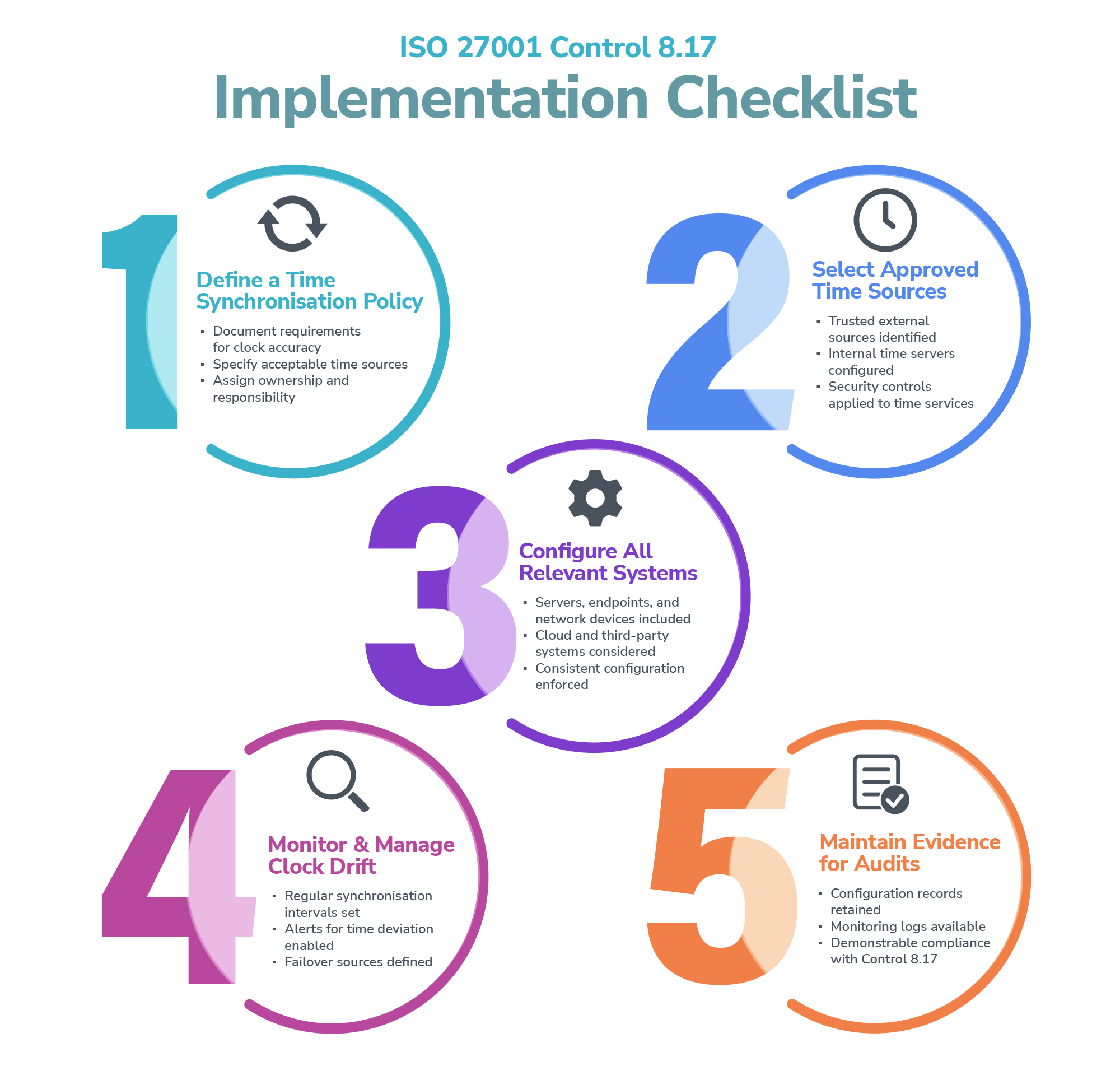
Despite receiving limited attention, clock synchronisation sits at the core of operational integrity. It ensures that in the event of an incident, security teams can trust the data they are presented with. Without clock synchronisation, logs lose meaning, alerts lose sequence, and evidence loses credibility. Ultimately, synchronised clocks are a cornerstone of trust in every security and operational decision.
With 20 years of experience providing ISO 27001 support to organisations, URM is the ideal partner to support any aspect of your organisation’s conformance/certification to the Standard. Our team of consultants can offer a wide range of consultancy services to help you achieve a smooth and successful ISO 27001 implementation. For example, we can start by conducting an ISO 27001 gap analysis where we establish your current level of conformance, identifying any areas that require improvement. We can also help you conduct your risk assessment using our proven risk assessment tool, Abriska 27001. Following this, we can support your development of policies, processes and information security management system (ISMS) infrastructure that are aligned with both the Standard’s requirements and with your organisation’s unique style, culture and needs. In addition, URM can offer a range of internal audit services, including conducting an internal audit ahead of your certification assessment to ensure your organisation is conformant, planning and implementing a full 3-year ISO 27001 audit programme, or auditing more specific aspects of the ISMS or particular controls.
To enhance your own or your team’s understanding of information security, URM regularly delivers ISO 27001-related training courses. Our Introduction to ISO 27001 Course explores all aspects of information security and the importance of ISO 27001 in safeguarding information, whilst our Certificate in Information Security Management Principles (CISMP) Training Course will fully prepare you to sit and pass the BCS invigilated examination and gain an industry-recognised information security qualification.


Having been involved in over 500 successful ISO 27001 certifications, URM is ideally placed to advise you on the essential activities and tasks you will need to carry out in order to maintain and improve your ISO 27001 auditing function and programme
A short, free, non‑commitment call can help you clarify scope, understand regulatory expectations, and align your approach across standards such as ISO 42001 and NIST AI RMF. Early guidance often saves time and avoids fragmented compliance efforts.
Whether you are at an early planning stage or preparing for audit and assurance activities, we offer a free introductory call to help you assess risks, responsibilities, and the most proportionate route forward.

URM’s blog drills down into ISO 27001 audits, offering advice on how to effectively develop and implement an ISO 27001 conformant audit programme.

Due to the increased use of technologies and the ‘human’ involvement, it is inevitable we are all going to face more and more information security incidents.

On 22 February 2024 ISO and IAF released a joint statement relating to an amendment to a total of 31 existing Annex SL management system standards.
