
Upcoming events
Webinar
Making PCI DSS Work for Your Business: Understanding Flexibility in PCI DSS v4.0
11:00 am
|
Wednesday
|
14
October
2026
Alastair Stewart explains how customised approaches, compensating controls and targeted risk analyses can provide flexibility without compromising security or compliance.
Read more

Webinar
Achieving and Maintaining ISO 27001 Certification: Practical Lessons from Supporting 500 Organisations
11:00 am
|
Wednesday
|
21
October
2026
URM and BSI will share practical insights gained from more than 20 years of helping organisations implement, certify, maintain, and continually improve their ISMS.
Read more
In-Person Event
Cyber Risk and Financial Resilience
What Every Finance Leader Needs to Know
8:30 am
|
Thursday
|
22
October
2026
Join our cyber security breakfast in Reading and discover how finance leaders can understand cyber risk and better protect their business.
Read more
Recent blogs

ISO 27001 Clause 4.2, Understanding the Needs and Expectations of Interested Parties
Published on
02
October
2026
TRENDING
URM's blog examines ISO 27001:2022 Clause 4.2, covering interested parties, their requirements and how these are addressed through the ISMS.
Read more

Information Security
Published on
21/9/2026
ISO 27001 Clause 4.1 - Understanding the Organisation and its ContextTRENDING
URM's blog explores ISO 27001 Clause 4.1 & how to identify organisational context, assess internal/external issues, and support effective ISMS decision-making.

Information Security
Published on
28/8/2026
Auditing ISO 42001: Its Unique Requirements and Key Differences From ISO 27001TRENDING
URM's blog examines how the ISO 42001 management system requirements differ from ISO 27001, and the impact this has on what auditors will expect to see.

Data Protection
Published on
21/8/2026
Retention of Personal Data in the UK: Common Pitfalls and How to Avoid ThemTRENDING
URM's blog explores common personal data retention mistakes, UK GDPR requirements for data retention & practical steps to reduce compliance and security risks.
Recent podcast
Talk BC
Season
3
, Episode
5
(
105
)
Successful Business Continuity Exercises: From Planning to Practice
TRENDING
In this episode of InfoSec Insider – Talk BC, Phil Knight, Senior Consultant at URM, explores the different types of business continuity exercises organisations can undertake and what makes an exercise genuinely effective. Drawing on his extensive experience supporting organisations with business continuity and resilience, Phil discusses:
- The different types of business continuity exercises, from walkthroughs and tabletop exercises to simulations and full-scale exercises
- How to choose the right type of exercise based on your organisation’s needs, objectives and available resources
- The importance of realistic scenarios, careful planning and securing stakeholder buy-in
- The role of effective facilitation in keeping participants engaged and ensuring exercises deliver meaningful results
- How to capture lessons learned and turn the outcomes of an exercise into practical improvements to business continuity arrangements
Phil also shares real-world examples of business continuity exercises, demonstrating how realistic testing can uncover gaps that may otherwise remain hidden until a genuine disruption occurs.
Recent VIDEO
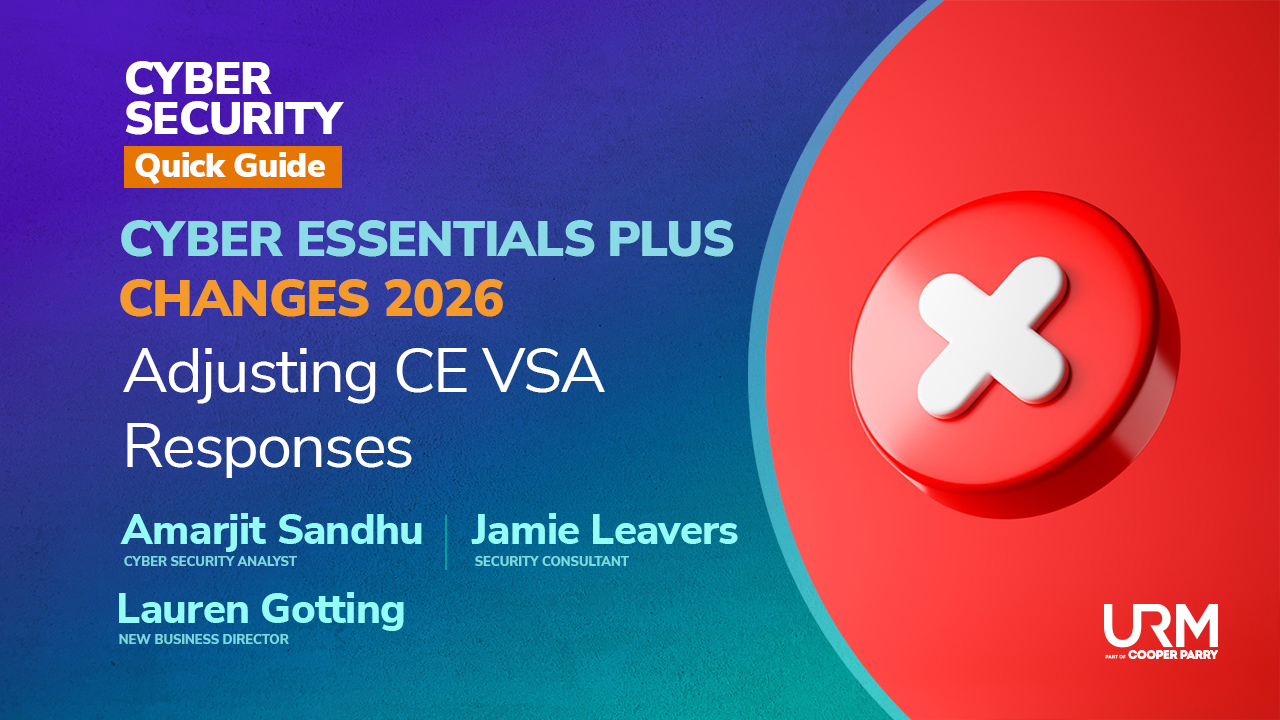
Cyber Essentials Changes in 2026 – Adjusting CE VSA Responses
We explain IASME’s clarification on adjusting CE VSA responses once CE+ testing has started.
Watch the videoRecent quiz

Business Continuity Awareness Quiz
TRENDING
By completing the quiz, you will gain a clearer understanding of how organisations prepare for, respond to, and recover from disruption, and why business continuity is a shared responsibility rather than a purely technical or specialist function.
Take the quiz
FAQs

ISO 27001 FAQs
How long does it take to implement ISO 27001?
There is no straightforward answer to this question as it depends on the size and complexity of your organisation, what systems and processes are already in place and what resources are available. However, in URM’s experience it typically takes between 6 and 9 months for a small, low complexity organisation to fully implement ISO 27001.
With larger, more complex environments, 9 to 18 months is closer to the norm for fully establishing an ISMS. This naturally assumes that the appropriate resources are made available to achieve the desired outcomes.
Apart from the existing maturity of operational practices and controls and availability of in-house resource, another key determinant in how long an ISO 27001 implementation will take place will be the support and involvement of senior management. URM has seen organisations achieve very aggressive timescales in implementing and achieving ISO 27001 certification where Senior Management has prioritised the project, often associated with being awarded a significant client project.
Is there a legal requirement to comply with or be certified to ISO 27001?
There is, generally, no direct legal requirement for compliance as such, indicating why many people choose to use the word conformance rather than compliance. Organisations choose whether or not to implement the requirements of ISO 27001 based upon the benefits that would be gained by doing so. However, you should pay close attention to any contractual obligations you may have for protecting the information of clients and other stakeholders.
There is an increasing trend where customers require third party suppliers to implement or certify to ISO 27001, thus making it a legal requirement, by virtue of a contract.
What does ISO 27001 require you to do?
A key requirement of ISO 27001 is that you adopt a risk-based approach when implementing your ISMS. You are also required to ensure that certain processes are in place to ensure effective and proactive management and continuous improvement.
These requirements are broken down into 7 major clauses, which deal with context of the organisation, leadership, planning, support, operation, performance evaluation and improvement. These clauses are consistent with other ISO Management system standards such as ISO 9001 and ISO 22301, and is known as the harmonised structure.
When was ISO 27001 last updated?
The current version of the Standard, ISO/IEC 27001:2022 replaced the 2013 version of the Standard on 25 October 2022. As of 1 May 2024, all initial and recertification assessments must be conducted against ISO 27001:2022 and, on 31 October 2025, all ISO 27001:2013 certificates will be withdrawn. Whilst the management system clauses received a relatively minor makeover in order to harmonize ISO 27001 with other standards, the information security controls contained within Annex A were completely restructured with some controls being merged with others as well as 11 new ones being introduced.
Recent case studies
ISO 27001, ISO 22301, ISO 20000 and PCI DSS consultancy and product-related case studies



Recent White paper

Cyber Essentials and Cyber Essentials Plus Changes 2026 Summary
Release date:
17
April
2026
In this document, we outline the key changes to Cyber Essentials and Cyber Essentials Plus scheme and what they mean for you as applicants.
Read more
Training Courses

Course type:
OnlineDATE:
19
November 2026
-
19
November 2026
Location:
The course provides clear and practical instruction and guidance on dealing with all aspects of a data subject access request (DSAR).
Register


URM can offer a range of support services when applying for Cyber Essentials Certification. Check our offer!
Find out more
how URM CAN HELP?
URM CONSULTING services
Book FREE Consultation
URM is pleased to provide a FREE consultation on Transitioning to ISO 27001:2022 for any UK-based organisation.
Read more
URM CONSULTING services
ISO 27002:2022 Update
If you want to learn more about ISO 27002:2022 and how to implement the new controls and the new attributes, you can attend URM’s ISO 27001:2022 Control Migration Course.
Read more
URM CONSULTING services
Unsure how PCI DSS applies to your environment?
You do not need a fully scoped programme to speak with us. We offer a free call to help you understand your PCI DSS obligations, clarify scope, and identify practical next steps. Early insight can significantly reduce complexity and cost
Read more
"
We regularly work with URM to achieve Cyber Essentials and Cyber Essentials Plus certifications, for us and our clients. We couldn’t be more impressed with their service. From start to finish, their team provided expert guidance, making the entire process seamless and stress-free.
contact US
Let us help you
Let us help you in your compliance journey by completing the form and letting us know how we can best support you.