The Subtleties of Scheduled Tasks in PCI DSS
TRENDING
PUBLISHED on
17
July
2026


In this blog, Alastair Stewart, Senior Consultant and Qualified Security Assessor (QSA) at URM, examines the often-overlooked challenges associated with Payment Card Industry Data Security Standard (PCI DSS) scheduled activities and the importance of correctly interpreting requirements such as weekly, quarterly, annual, and periodic tasks. He explores how timing and evidence collection can create compliance risks, while highlighting the expectations assessors apply during audits. The blog also outlines practical measures to improve scheduling, ownership, automation, and monitoring, helping ensure recurring security activities are completed consistently and effectively.
In our experience, one of the most commonly overlooked aspects of PCI DSS is not the control itself, but the timeframe associated with it. Requirements that must be performed weekly, quarterly, annually, or ‘periodically’ appear straightforward on paper, yet in practice they introduce ambiguity, audit risk, and operational burden. Understanding how these intervals are interpreted, and how to ensure tasks are completed consistently and accurately, is essential to maintaining PCI DSS compliance.
PCI DSS defines a number of recurring tasks across its requirements. These include activities such as vulnerability scanning, log review, user access review, and incident response testing. At first glance, terms like ‘quarterly’ or ‘annually’ appear precise, but the Standard’s intent introduces nuance.
A quarterly task, for example, is not simply ‘four times per year’. It is generally interpreted as occurring at intervals that do not exceed 90 to 92 days. So, you cannot cluster scans close together during a particular period of the year and still claim compliance. Assessors expect an even cadence, with evidence demonstrating that no quarter was skipped or significantly delayed.
Similarly, annual tasks are expected to occur once every twelve months, but the subtlety lies in timing drift. If an incident response test is performed on 1 January one year and then on 31 December the next, the interval technically remains under twelve months and therefore compliant. However, over successive cycles this drift can accumulate and may eventually result in non-compliance. As such, many assessors will expect you to anchor annual activities within a defined window rather than allowing them to float without any restrictions or boundaries.
Weekly tasks, such as log reviews, are subject to even stricter interpretation. In practice, weekly is typically understood to mean every seven days, rather than simply once within a calendar week. Missing a week or performing multiple reviews in one week does not compensate for a missed interval. The expectation is consistent, continuous monitoring.
The Standard also uses less precise language such as ‘periodically’ or ‘as needed’ for certain requirements. These phrases deliberately allow flexibility but require organisations to define and justify their own intervals. Without a documented rationale, the intervals defined by your organisation can quickly become a point of contention during a PCI DSS assessment.
PCI DSS version 4.0 has further emphasised the importance of defined frequencies by introducing more explicit expectations for targeted risk analyses (TRAs). In some cases, organisations can determine custom frequencies for certain activities, but only if supported by a documented, risk-based justification. This shifts responsibility onto your organisation to demonstrate that the interval it has selected is appropriate. To learn more about TRAs, read our blog PCI DSS v4.0: Targeted Risk Analysis.
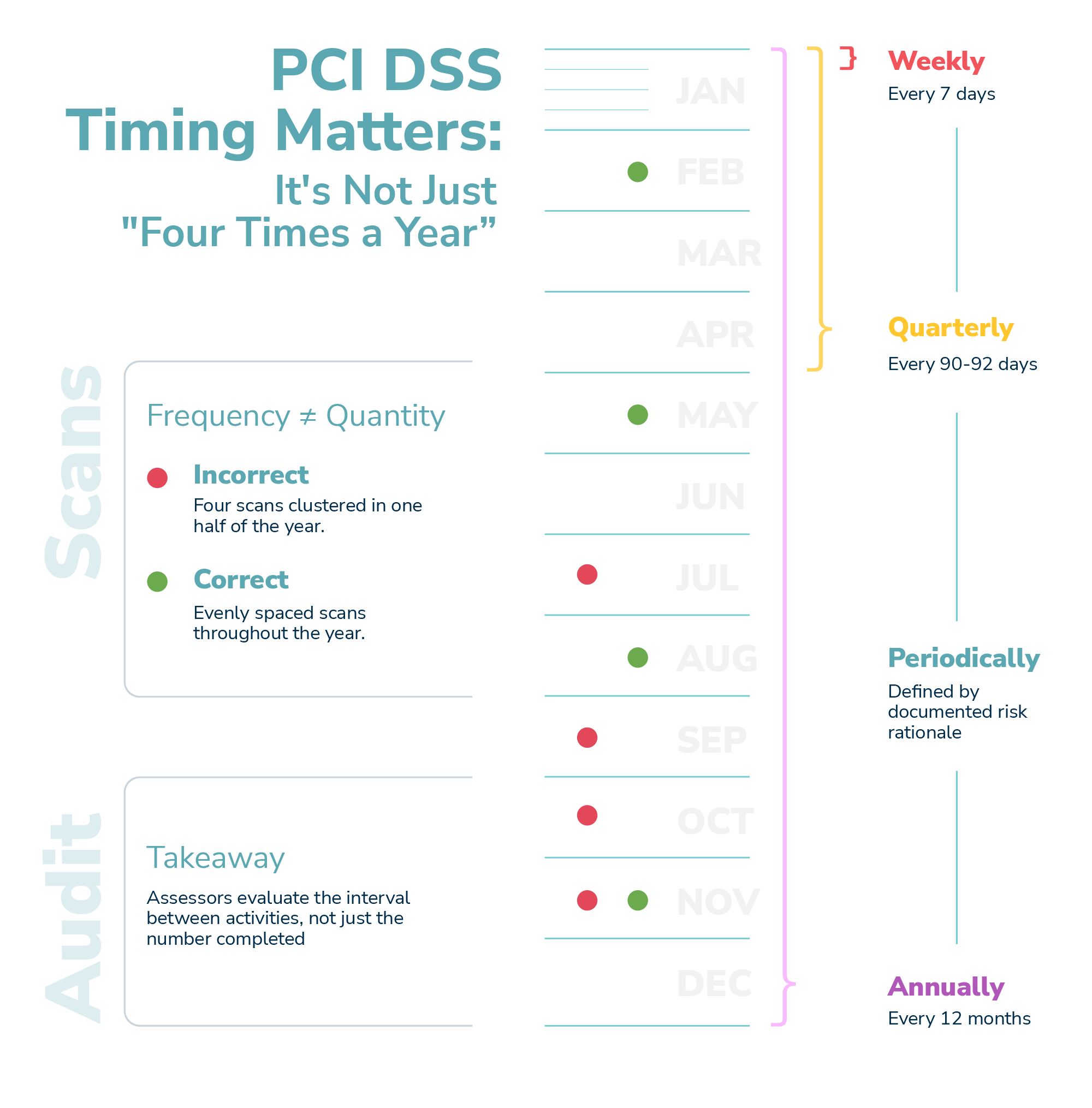
The difficulty lies not in the wording itself, but in its application. If your organisation operates across multiple time zones, business units, and systems, each with different dependencies, aligning all scheduled tasks to a strict cadence can be challenging.
Another subtle issue is evidence. It is not sufficient to just perform a task; you must also prove that it was performed within the required interval. Gaps in evidence, even when the task was completed on time, can lead to non-compliance findings. We often see this become particularly problematic for manual processes such as access reviews or log checks, where documentation may be inconsistent or held in different places. In these situations, the issue is rarely that the activity has not happened; more often, it is that the organisation cannot demonstrate it clearly and quickly when asked.
There is also a tendency to treat scheduled tasks as isolated controls rather than part of a continuous control environment. For example, quarterly vulnerability scans are sometimes treated as a standalone compliance exercise when, in reality, they should form part of a broader ongoing vulnerability management programme. This mindset increases the risk of missed deadlines and superficial execution.
To address these challenges, you will need a structured and disciplined approach.
First, scheduled tasks should be centralised within a compliance calendar. This calendar should define each task, its frequency, its owner, and the acceptable window for its completion. Instead of relying on broad terms like ‘quarterly’, we would recommend translating these into specific due dates or recurring schedules.
We would also encourage automation wherever possible. Automated vulnerability scans, log monitoring tools, and ticketing systems can enforce frequency and generate evidence. Automation reduces reliance on human memory and helps ensure consistency across reporting periods.
You will need to define acceptable tolerance windows. For example, a quarterly task might be required to occur every 90 days with a small grace period. This tolerance should be documented and consistently applied; without it, even minor scheduling delays can create audit issues.
Strong ownership of compliance activities is essential. Each task needs to have a clearly assigned owner who is accountable for completion and evidence collection. We have observed on a number of occasions how shared ownership can lead to missed deadlines, as responsibility becomes diluted.
Instead of being treated as an add-on or afterthought, evidence capture needs to be built into your compliance processes. Each scheduled activity should produce artefacts such as reports, logs, or sign-offs that are stored in a central repository and clearly show the date of completion, as well as the scope of the activity.
Finally, internal monitoring and escalation mechanisms are critical. Dashboards that track upcoming and overdue tasks can provide early warning of compliance risks, while regular internal reviews help identify patterns, such as recurring delays or incomplete documentation, before they become audit findings.
The most mature organisations treat PCI DSS scheduled tasks as components of a broader control framework, aligning these activities with operational processes, integrating them into existing tooling, and continuously monitoring their effectiveness.
This approach reduces the risk of last-minute remediation and improves the organisation’s overall security posture. More importantly, it ensures that the intent of PCI DSS is met. Ultimately, the aim is not simply to perform tasks at prescribed intervals for the sake of ticking a compliance box, but to maintain continuous, effective security controls. From what we see in practice, the organisations that manage this well are usually those that treat scheduling as part of day-to-day control discipline, rather than something to revisit only when an assessment is approaching.
URM provides structured, end-to-end support to help organisations achieve and maintain compliance with the PCI DSS in a practical and efficient way.
Establishing a clear understanding of your current position and obligations:
Guiding you through the steps required to achieve and sustain compliance and facilitating a smooth and successful assessment:
URM’s experienced QSAs ensure your approach is not only compliant, but also efficient, risk-focused, and aligned with your business operations.


Having been involved in over 500 successful ISO 27001 certifications, URM is ideally placed to advise you on the essential activities and tasks you will need to carry out in order to maintain and improve your ISO 27001 auditing function and programme
A short, free, non‑commitment call can help you clarify scope, understand regulatory expectations, and align your approach across standards such as ISO 42001 and NIST AI RMF. Early guidance often saves time and avoids fragmented compliance efforts.
Whether you are at an early planning stage or preparing for audit and assurance activities, we offer a free introductory call to help you assess risks, responsibilities, and the most proportionate route forward.

In this article, we aim to clarify what requirements the Payment Card Industry Data Security Standard (PCI DSS) places around....

We address a number of key questions: What are the Main Contents? What Led to it Being Published? And others.

URM’s PCI DSS gap analysis service is aimed at those organisations which are looking to benchmark....
