ISO 27001 Clause 8.1: Effective ISMS operational planning and control
TRENDING
PUBLISHED on
03
July
2026


In this blog, Stuart Moran and Warren Howard, Senior Consultants at URM, explain the requirements of ISO 27001 Clause 8.1 and the role it plays in ensuring that information security processes are effectively planned, implemented, and controlled. They explore how organisations can embed information security into day-to-day operations through clear process design, defined responsibilities, effective documentation, performance monitoring, and structured change management. The blog also provides practical guidance on translating the high-level requirements of the Standard into consistent, repeatable operational practices that support an effective and resilient ISMS.
An information security management system (ISMS) is only as effective as the processes that support it. Organisations may identify risks and establish policies, but real security is achieved through the execution of day-to-day operational activities.
Clause 8.1 of ISO 27001 is directly influenced by Clause 4.4 of the Standard, which states that organisations must ‘control the processes needed and their interactions’. However, whilst Clause 4 is concerned with the planning of the ISMS, Clause 8 defines requirements relating to the execution or ‘doing’ of effective ISMS implementation, and ensuring these processes are properly planned, implemented, controlled and monitored so that information security requirements are consistently and reliably met. In essence, this requirement reflects that whilst many organisational processes will be carefully planned and controlled, the output of one element or process typically forms the input into subsequent process(es), which can introduce a risk that during ‘handover’ between processes, key details may be omitted.
Clause 8.1 requires organisations to plan, implement, and control processes that meet information security needs. Again, it should be noted that Clause 4.4 also adds ‘and their interactions’ into the mix. The focus is on ensuring operational activities are carried out in a controlled, documented and managed way
In practical terms, Clause 8.1 requires that you:
In short, Clause 8.1 is about operationalising and embedding information security practices into business processes so that they are applied consistently, are repeatable, and are subject to clear accountability.
As with many ISO standards and clauses, Clause 8.1 provides baseline requirements for conformance, without stating specifically or practically how organisations should implement and manage these requirements in their day-to-day operations. Based on experience, the following points are important to consider.
Identify where each business process interacts with information assets, people, technology, or suppliers. Having established where these interactions exist, you can then determine which ISO 27001 controls apply and embed them directly into operational workflows to ensure that security becomes part of everyday operations, instead of a separate or isolated activity. Outputs may include artefacts such as RACI (responsible, accountable, consulted, informed) charts, process maps and control‑to‑process matrices. This type of mapping activity will typically involve all internal business functions and, where relevant and necessary, providers of external processes, products or services within the scope of the ISMS.
A common example of this in practice is the onboarding requirements for new staff, and the need for them to remain current with ISMS awareness / training. The onboarding process is typically structured and thorough; the subsequent frequency and testing of awareness, often less so. A process that records the acknowledgment of initial awareness training (and a measure of whether it has been understood, such as a quiz), could be followed by a process which then requires regular refresher training, and supporting processes which include escalatory measures if this training is not completed in a timely manner.
For each process, you will need to establish what ‘good’ or the ‘criteria for success’ look like. Requirements for acceptance criteria, control procedures, escalation routes, and evidence should be detailed (but not overly complex or inaccessible). Your aim should be to define these elements with sufficient clarity to create a consistent and repeatable approach that will prevent errors and reduce reliance on individual knowledge. This could be complemented by measures associated with Clause 9.1 (Monitoring, measurement, analysis and evaluation) to provide early indicators of a requirement for potential management intervention. To learn more about this Clause, read our blog Clause 9.1 Monitoring, Measurement, Analysis and Evaluation Explained.
For each security process, you will need to assign responsibilities to named roles, including the defined education, qualifications, training or experience (i.e., competence) that is needed to perform the associated activities effectively. Well-defined ownership and competency requirements help ensure accountability and make clear who is responsible for which security processes, reducing the risk of important activities being overlooked or performed inconsistently, while also preventing unnecessary duplication of effort or overlap.
Processes in this area should also include contingency or succession planning. In many cases, it is unlikely that a new incumbent in a particular post will possess all the skills required of the role. As such, a process to ensure that any gaps are identified and subsequently closed will help avoid oversight in this area.
Tasks and checkpoints should be embedded into tools your organisation already uses, such as ticketing systems, enterprise resource planning (ERP) workflows, finance systems, supervisory control and data acquisition (SCADA) systems or change management software. You should look to avoid creating separate or parallel security processes that operate alongside other business processes and require staff to duplicate effort or maintain information in multiple places. Instead, systems and security practices need to be integrated at the early requirements and planning stages. Improved integration will support better adoption of processes among staff, enhance process effectiveness, reduce operational friction, and will help make adherence to requirements routine.
The reality of change should also be a consideration. Improved integration may include efficiency gains, and adjustment to working practices or process flows. These should be carefully considered and measures implemented to ensure that the most effective methodologies are in place and obsolete process flows, diagrams or practices are removed from functional areas.
Policies, processes, procedures, work instructions, templates, logs, and evidence of operational activities need to be kept current. Documented information also needs to be lean, accurate, and accessible, without becoming unnecessarily complex or difficult to maintain. Records need to be effective and appropriate so that process control can be demonstrated, and to support efficient audits. An effective method of achieving this is via version control, archiving and, for hard-copy material, copy numbering. All too often, legacy documents lie unnoticed on notice boards or in server rooms. To mitigate this, copy numbered documents, and records of their locations, will enable each to be recovered and destroyed before being replaced with the most current version.
Processes need to be monitored through the use of elements such as metrics, KPIs, dashboards, internal audits, and management reviews to verify that processes are operating as intended and help identify gaps early. You need to establish efficient oversight to ensure that emerging trends, performance issues, control weaknesses and nonconformities are noticed and acted upon before they develop into significant issues that could threaten the integrity of the ISMS. Ultimately, monitoring should enable data-driven decisions regarding and continuous improvement of the processes and associated ISMS controls.
You will need to ensure that any change to processes, systems, suppliers, or controls are subject to your organisation’s change management process, including appropriate risk assessment, approval, testing, and verification activities. Here, you are looking to understand the potential impact of a change before it is implemented and confirm it has achieved its intended outcome without introducing new risks or weaknesses. Poorly controlled changes are a major source of security incidents and nonconformities, so a structured approach to change management is essential to allowing adaption and improvement of the ISMS while maintaining its effectiveness and reliability.
It is important to note that ISO 27001 addresses the topic of change in two distinct areas: Clause 6.3, which relates to changes to the ISMS, and in Control 8.32, which deals with organisational or technical changes. Both should be considered in parallel with each other, as a change which is effected in relation to Control 8.32 will almost certainly have a corresponding impact involving Clause 6.3.
To learn more about change management in ISO 27001, read our blog on ISO 27001 – Clause 6.3: The Importance of Planned ISMS Change Management.
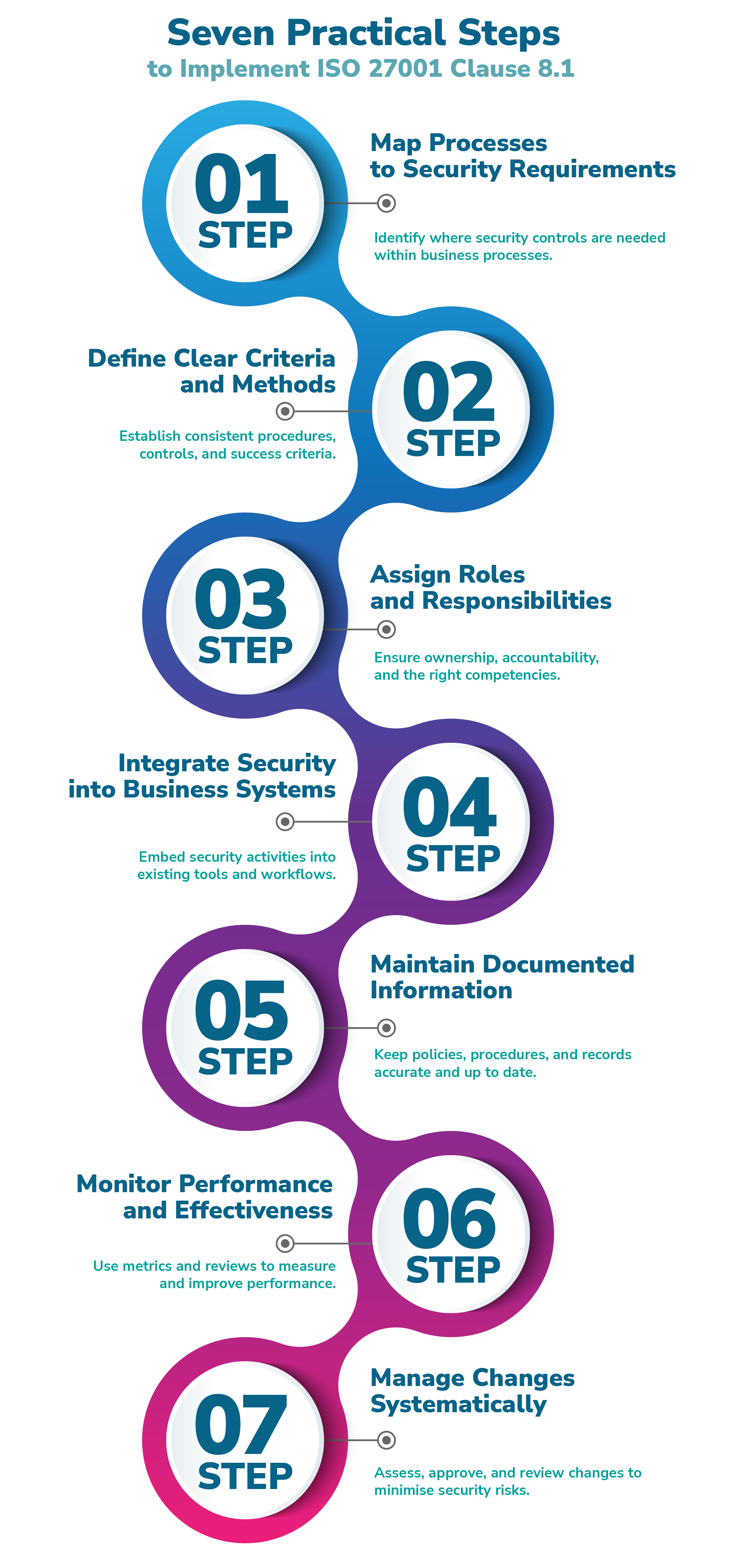
Clause 8.1 reinforces the need to plan, operate, monitor and continually control the processes that underpin an organisation’s ISMS. By embedding security into routine operations, maintaining clear criteria and documentation, monitoring performance, and managing changes in a structured way, organisations can ensure their information security practices remain consistent and effective. This disciplined operational approach helps safeguard information assets and supports sustained ISO 27001 conformance.
With over 20 years of experience supporting organisations in achieving and maintaining certification to ISO 27001, URM provides practical, expert-led guidance across every stage of the Standard’s lifecycle.
Helping you understand your current position and prioritise action:
Delivering hands-on support to build and validate your ISMS:
Providing continued expertise to maintain and improve your ISMS:



Having been involved in over 500 successful ISO 27001 certifications, URM is ideally placed to advise you on the essential activities and tasks you will need to carry out in order to maintain and improve your ISO 27001 auditing function and programme
A short, free, non‑commitment call can help you clarify scope, understand regulatory expectations, and align your approach across standards such as ISO 42001 and NIST AI RMF. Early guidance often saves time and avoids fragmented compliance efforts.
Whether you are at an early planning stage or preparing for audit and assurance activities, we offer a free introductory call to help you assess risks, responsibilities, and the most proportionate route forward.

Many organisations have had to adapt very quickly to the rapidly changing restrictions brought in across the globe to help combat the spread of COVID-19.

URM’s blog explains the purpose & requirements of ISO 27001 Clause 6.3, types of ISMS change it covers, and key considerations when putting it into practice.

On 22 February 2024 ISO and IAF released a joint statement relating to an amendment to a total of 31 existing Annex SL management system standards.
