Processing Children's Personal Data: A GDPR Guide
TRENDING
PUBLISHED on
20
November
2026


In this blog, Martin Brazier, Senior Consultant at URM, explores the key data protection considerations organisations need to address when processing children's personal data. He discusses:
When you handle children’s personal data, start by asking what could go wrong for the child, not just for your organisation. Getting it wrong can lead to regulatory action or compensation claims, and complaints from parents can do lasting damage to trust.
Recital 38 of the UK General Data Protection Regulation (UK GDPR) states that ‘children merit specific protection with regard to their personal data, as they may be less aware of the risks, consequences and safeguards concerned and their rights in relation to the processing of personal data’. Similarly, Article 3 of the UN Convention on the Rights of the Child (UNCRC) states that ‘in all actions concerning children… the best interests of the child shall be a primary consideration’.
These principles, providing children with additional protection and ensuring their best interests are at the forefront of decision-making, should underpin every stage of the planning and processing of children's personal data.
The UK has ratified the UNCRC and recognises that a child is any person under the age of 18. However, when considering data protection aspects, such as the ability to give consent to processing, different rules apply. When processing the personal data of children, there may be a need to consider someone with parental responsibility for the child, i.e., someone who has the legal rights and responsibilities for a child that are normally afforded to parents. This won’t always be a child’s ‘natural parents’ and parental responsibility can be held by more than one natural or legal person.
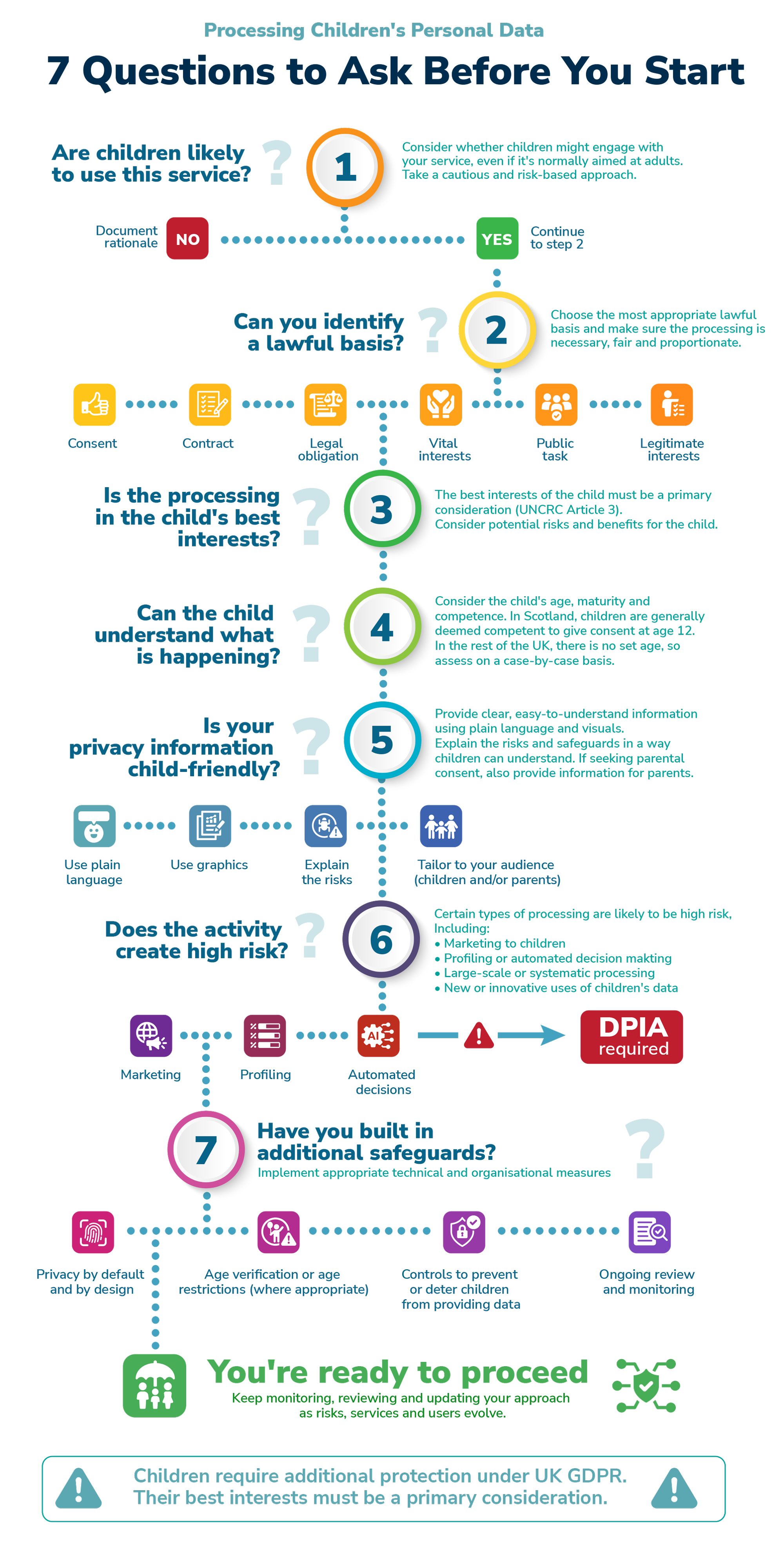
One thing we often see in our work: organisations assume a service is only used by adults because that’s who it was designed for. It’s worth asking whether children use it too, and what data you might already be collecting from them. The risk might not be high depending on the type of services and data processing, but we would suggest adopting a cautious and risk-based approach. One option is to apply safeguards to everyone who uses the service, so children are protected too. Where the risk to children is greater, you may need to introduce measures that prevent or deter children from providing data, enforce age restrictions or require age verification.
As with any personal data, the first data protection principle says that processing must be lawful, fair and transparent. Let’s start with how to choose a lawful basis for processing children’s data.
Adopting the lawful basis of consent means you will need to demonstrate that the children or those with parental responsibility have an informed choice and control, bearing in mind that even if consent is received, this doesn’t necessarily mean that processing is guaranteed to be fair.
In practice, the hard part is working out whether a child understands what they’re agreeing to and what could happen as a result. You'll therefore need to consider the competence of the children likely to be involved. Remember that only informed consent is valid. Also, you’ll need to consider any imbalance in the relationship between the controller and the child, or between the child and those with parental responsibility.
In Scotland, children are deemed of age to be competent to give consent at age 12, but there is no set age in the rest of the UK, creating the challenge of assessing competence on a case-by-case basis.
Here, you will need to make a similar assessment about the competence of the child to enter into a contract, which we often find can be difficult in practice. In Scotland, the legal age for children to enter into a contract is 16, but in the rest of the UK there is no defined age. The ICO recommends a rule of thumb that any child over 7 can enter into a contract but can withdraw from it without consequence.
As in any case of legal obligation, it is important to define that obligation, whether it is a statute or common law obligation. Remember that processing must be necessary, which means that it must be a targeted, proportionate, and reasonably effective way to achieve a specific, legitimate purpose; it can’t be just convenient or desirable.
This only applies to life-or-death situations and again it must be necessary for that purpose. As such, this lawful basis would apply only in very specific circumstances and we very rarely see organisations use it, but those circumstances are likely be different from those to protect the vital interests of an adult.
This lawful basis usually applies to public authorities, such as children’s services or the family courts, and the concepts from the UNCRC apply so that processing should be in the best interests of the child.
For this lawful basis, you will need to complete a legitimate interests assessment (LIA), which:
The third point is crucial and sets a high bar to protect children from risks they might not understand, and it is your duty (not the child’s) to ensure that their interests are protected. You must put the child’s interests first. You also need to consider what the child might reasonably expect you to do with their personal data. To do this, we always stress the importance of taking into account the age range of data subjects and bearing in mind that younger children need more protection and should have less autonomy than older children.
If services are normally aimed at adults, we would also advise that you consider whether children will be interested in the same services, and whether children’s data might be processed unknowingly. Similarly, if a service is aimed at older children, might younger children also be interested in those services?
When looking at the fairness of processing, we find it is a useful benchmark to anticipate what data subjects would reasonably expect. This can be more difficult to assess for children, but again the UNCRC concept of acting in the child’s best interests as a primary consideration will be helpful.
Article 12 of the UNCRC says that a child who is capable of forming their own views has the right to express those views freely in all matters affecting them, and that the views of the child should be given due weight in accordance with their age and maturity. If you’re designing a service for children, consider talking to children or running a focus group. Ask what they’d expect you to do with their data. Their answers can help you spot risks you might have missed and decide which safeguards would help.
The UK GDPR requires that the same information be provided to children that is required for adults. However, children may be less aware of the risks associated with processing, so it is important to explain those risks and the safeguards in place to protect them.
To get the message across, it is important to write in a child-friendly way and consider the use of graphics to help communicate information. If you are aiming to obtain parental consent, aim the transparency information at the parent but remain aware that the child doesn’t lose any rights if the parents consent. A useful test is whether a child can explain, in their own words, what happens to their data, while a parent can still find the detail they need.
When marketing to children, the ICO recommends that a data protection impact assessment (DPIA) be completed because it is likely to result in a high risk. The UK GDPR states that children’s personal data merits specific protection, particularly the use of their data for marketing purposes or creating personality or user profiles.
Using children’s personal data for marketing purposes can include both using personal data to send marketing messages to individual children (direct marketing) and using personal data to display targeted adverts in an online context (behavioural advertising).
The UK GDPR applies to children as it does for adults, so processing must be fair and comply with the data protection principles. A lawful basis must be identified, and transparency information must explain what you are doing with their personal data in a way that they can understand, which we find organisations sometimes struggle to achieve.
However, children must be specifically protected when their personal data is processed for marketing and you cannot exploit any lack of understanding or vulnerability. When a child provides personal data, they may not fully understand that it might be used to market to them or be able to properly assess marketing content, which could result in them receiving unwanted marketing, spending unnecessarily or making poor choices on content or services.
When it comes to automated decision making and profiling, much of the rules that apply to adults also apply to children. Again, a DPIA will be mandatory because the ICO considers this to be high risk. Decisions shouldn’t be made purely by automated means if those decisions have a legal or similarly significant effect on data subjects, unless it is for the performance of a contract, authorised in law or based on explicit consent and suitable safeguarding measures are taken.
Recital 71 of UK GDPR says that automated decision making and profiling should not concern a child, but that is not reflected in the UK GDPR Articles or the Data (Use and Access) Act 2025. However, this is a clear sign that automated decision making and profiling involving children should be the exception and not the norm.
This is also known as the right to be forgotten, i.e., to have personal data held by an organisation deleted under certain circumstances. The Recital 65 in the UK GDPR says that this right is relevant in particular where the data subject consented to processing as a child while not fully aware of the risks involved by the processing, and later wants to remove personal data, especially on the internet. They should be able to exercise that right even if they are no longer a child.
As the requirement in UK GDPR Recital 38 is that children merit special protection and the UNCRC requires that controllers act in the child’s best interest, you need to comply with a request for erasure whenever you can. In addition, it should be as easy to get the information erased as it was to provide it. For example, if you could collect the information without identifying the data subject through documentation, it should not be required to erase it.
Also, we would always stress that the right to erase does not need to be exercised by the same person who provided consent. If consent was provided by someone with parental responsibility, this does not mean that only they can request erasure, especially if the child is now an adult. Also, if the child provided consent, you should not accept a request to erase from a parent without asking the child.
One of the trickier situations we see is when a child and parent disagree, or when a child asks you to delete their data without telling a parent. There’s no blanket rule. Look at what the child understands and what’s in their best interests, and decide case by case.
This is the right of data subjects to know about how information is being processed about them and to receive a copy of that information. This is often made by what is known as a data subject access request (DSAR).
This right is the same for children as adults, and a child can exercise the right on their own behalf if they are competent to do so (or are over 12 in Scotland). This is assessed depending upon the level of understanding of the child. However, you should never consider a child competent when it’s clear that they’re acting against their own best interests. If you have decided that a child is competent to provide their own consent, then it will usually be reasonable to assume they are also competent to exercise their own data protection rights.
The child can instruct or authorise someone to act on their behalf, such as a parent, another adult, or a representative such as a child advocacy service, charity or solicitor. Parents are only generally allowed to exercise rights on a child’s behalf if the child authorises them to do so or does not have sufficient understanding to exercise the rights themselves, or when it is evident that this is in the best interests of the child. Even if a child is too young to understand the implications of their rights, those rights still belong to the child and not to their parents or anyone else acting on their behalf.
Where a child doesn’t have sufficient understanding to exercise their rights themselves, it will usually be appropriate for someone with parental responsibility to do so on their behalf. However, this may not be appropriate if there is evidence that it would not be in the child's best interests.
If you’re confident that the child can understand their rights, then you should usually respond directly to the child. However, they may choose to have a parent exercise their rights on their behalf, or it may be appropriate for a parent to do so where this is clearly in the child's best interests.
The key issue is whether the child can understand and deal with the implications of exercising their rights. Do they know what it means to request a copy of their data and how to interpret the information they receive as a result of doing so? In our experience, this is not always clear and can be difficult to determine, so you need to take into account:
Processing children’s personal data can be complex and comes with risks, both to the children in question and to the organisation processing it, including the risk of conflict with parents. In our work supporting organisations’ data protection compliance, we always stress the need to keep Recital 38 in mind; children merit specific protection with regard to their personal data, as they may be less aware of the risks, consequences and safeguards concerned and their rights in relation to the processing of personal data.
This means taking greater care with the processing and protection of children’s data, and a higher bar for achieving and demonstrating compliance. There is also the added responsibility for taking into account what is in the best interests of the child. In practice, that means looking again at your lawful basis, how you explain what you do with children’s data, how you market to children and how you handle their rights requests. A thorough DPIA, consultation where feasible and strong privacy settings by default can help you protect children and meet your obligations without getting in the way of the services children need.
With extensive experience helping organisations achieve and maintain GDPR compliance, URM provides practical, expert-led support across all aspects of data protection.
Helping you understand your current compliance position and implement effective improvements:
Providing specialist GDPR support to help you manage ongoing compliance obligations and respond effectively when issues arise:
Building the knowledge and skills required to maintain effective data protection practices:


We offer a free, no‑obligation call to help you understand your current data protection position and identify the most practical next steps
If you are unsure how GDPR applies to your organisation, we offer a free introductory call to help you understand risks, responsibilities, and practical next steps. There is no commitment, just clear, informed guidance.
We offer a free, no‑commitment call to help you understand your obligations, assess where you stand, and decide what action is proportionate for your organisation. Early clarity can save time, effort, and unnecessary compliance work.

The GDPR (EU) 2016/679 is an EU regulation which came into effect on 25 May 2018 and set a new benchmark for the processing of personal data.

URM’s blog discusses the importance of LIAs for maintaining compliance with the GDPR, as well as providing a step-by-step breakdown of how to conduct one.

A DPIA delivers a pre-emptive approach to assessing these risks, and can prevent a data breach occurring. We present an outline of steps in conducting a DPIA
