Building an Effective Statement of Applicability (SoA)
TRENDING
PUBLISHED on
13
November
2026

In this blog, Wayne Armstrong and Frazer Grudgings, Senior Consultants at URM, draw on their experience of supporting organisations with ISO 27001 to explain the purpose of the Statement of Applicability (SoA). They share practical observations on how organisations can turn the SoA from a compliance requirement into a valuable information security management tool, including:
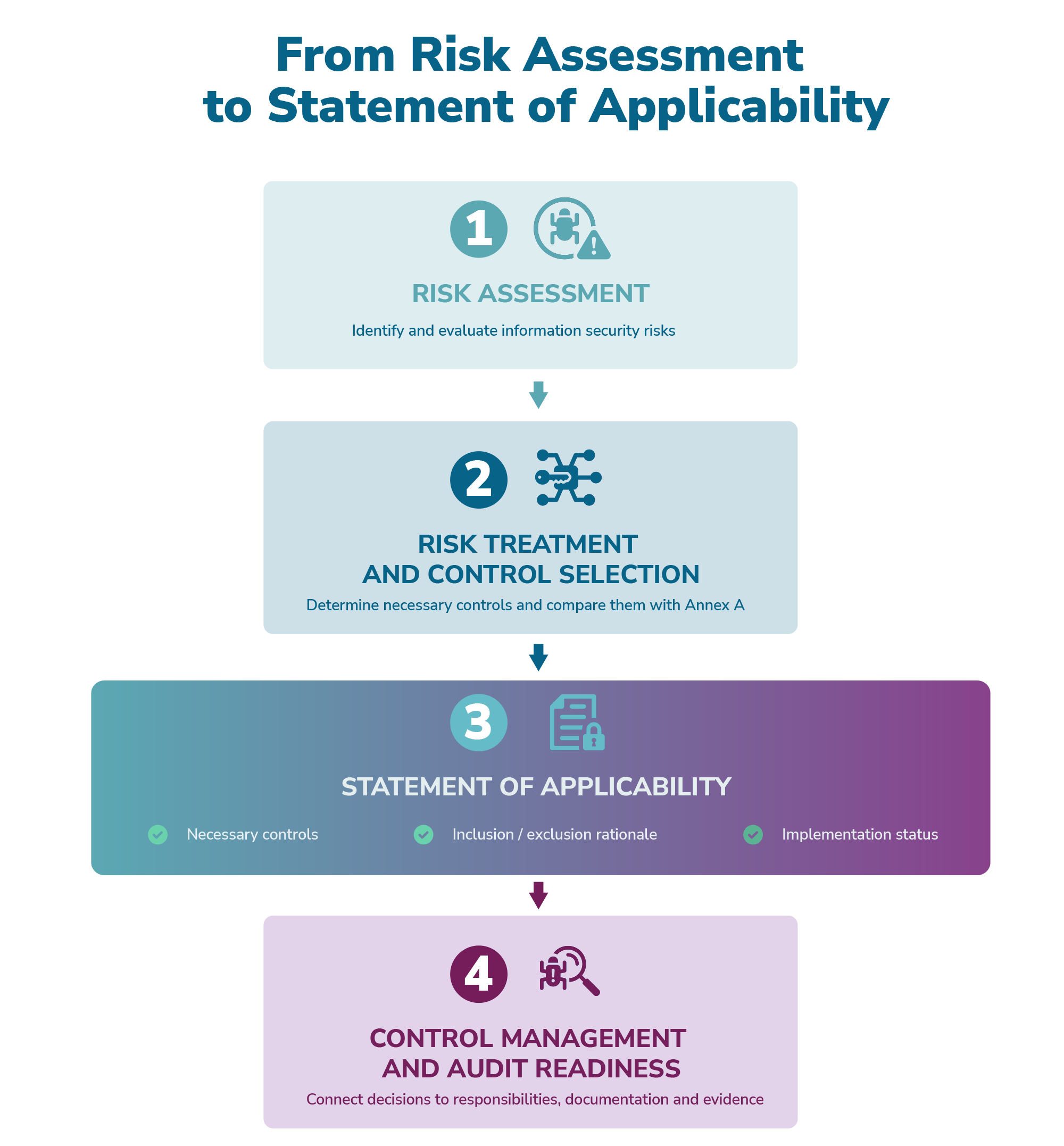
The Statement of Applicability (SoA) is a mandatory document required by Clause 6.1.3 of ISO 27001. It records the controls an organisation has determined are necessary, whether those controls have been implemented, and the justification for including or excluding Annex A controls.
In our experience, the most useful SoAs do much more than demonstrate conformance. When developed thoughtfully, the SoA provides a clear and practical link between an organisation’s risks, control environment and information security objectives. It can also become a valuable reference point for control owners, senior management and auditors.
Clause 6.1.3 of ISO 27001 states that ‘the organisation shall define an information security risk treatment process to:
b) determine all the controls that are necessary to implement the information security risk treatment option(s) chosen;
c) compare the controls determined in 6.1.3b with those in Annex A and verify that no necessary controls have been omitted;
d) produce a Statement of Applicability that contains;
- the necessary controls determined in 6.1.3b &c
- justification for their inclusion;
- whether the necessary controls are implemented or not;
- the justification for excluding any of the Annex A controls’.
So, how do you create an SoA that meets these requirements while also adding value to the organisation and its information security management system (ISMS)?
Most of the SoAs we encounter are maintained in spreadsheets. In our experience, this is usually a practical approach because the organisation needs to record information against all 93 Annex A controls. A spreadsheet also provides the flexibility required to review and refine the SoA as the ISMS evolves. The tool itself, however, is less important than the quality of the decisions and explanations it records.
We have noted several core components of an effective SoA that can form the column headings used in the document.
Control number
Reference number for the control.
Control title
The title of the control.
Control description
The description of the control as set out in Annex A of the Standard.
Implementation status
Indicates whether the control is fully implemented, partially implemented or not implemented. The concept of partial implementation is particularly important, as many Annex A controls comprise multiple requirements rather than a single activity. For example, Control 8.13 (Backups) requires that backups are maintained and regularly tested in line with a subject-specific policy. We have often encountered situations where an organisation may have approved a backup policy and implemented backups but may not yet have established or completed regular restoration testing. Recording the control as partially implemented makes that position transparent and allows the remaining action to be managed.
Selected yes/no
Shows whether the control has been selected.
Justification
This column is important because it records the rationale for including or excluding a control, which should be driven by your risk treatment plan. For example, a control may be required to meet a legal, regulatory or contractual obligation. Where this is the case, it is useful to reference the specific legislation, regulation or contractual obligation, as this allows readers to refer to the underlying requirement if further detail is needed.
Meanwhile, if a control has been deemed not applicable, this should be clearly justified. For example, you may classify Control 8.30 (Outsourced development) as not applicable if all development activities are carried out in-house and no third parties are involved. Documenting the reasoning in the SoA makes it clear that the control has been considered as part of the risk treatment process and intentionally excluded, reducing the likelihood of challenges or nonconformities during an audit.
A useful test is to ask whether someone who was not involved in creating the SoA could understand why the control was included or excluded. If the answer is no, the justification probably needs more context.
Supporting documentation
Although this column is not required by the Standard, we recommend including it as a matter of good practice. A supporting documentation column links the control directly to internal policies, technical configurations, or operational procedures, demonstrating your organisation’s documented intent to manage the relevant control. You can then support this by indicating how the control can be evidenced during an internal or external ISO 27001 audit, such as by linking to associated records or referencing the system where the evidence can be obtained.
One of the most common weaknesses we encounter is a control being included or excluded without a clear connection to the organisation’s risk assessment and risk treatment process. A reader should be able to understand why a control was selected, such as the particular risk it helps to treat, or why it was excluded, such as the relevant activity not being performed by the organisation.
Another common issue is treating the SoA as a one-off certification document. We recommend reviewing it at least annually and whenever a material change affects the ISMS. This might include the introduction of a new technology, a significant change to services or suppliers, an acquisition, or a change to legal or contractual obligations.
We have also seen SoAs become dependent on the knowledge of one individual. An effective SoA should instead reflect input from relevant stakeholders across information technology, legal, human resources and senior management. This helps ensure that the document reflects how controls actually operate across the organisation.
Finally, avoid generic explanations such as ‘not applicable’. For example, if your organisation excludes a physical access control because it operates entirely remotely and has no corporate office, record that context. A specific explanation demonstrates that the control was consciously considered rather than overlooked.
As demonstrated above, Clause 6.1.3 of ISO 27001 makes clear that the information security controls listed in Annex A are not exhaustive and additional information security controls can be included if needed. Some organisations we work with choose to go beyond the requirements of ISO 27001 by implementing more advanced controls than the 93 listed in Annex A.
It is also important to remember that ISO 27001 is only updated periodically, while threats, technologies and business practices can change much more rapidly. In practice, organisations sometimes need controls that reflect emerging technologies, sector-specific risks or contractual requirements that are not expressly described in Annex A. The SoA provides a useful place to record those controls, explain why they are needed and identify the supporting evidence.
With over 20 years’ experience supporting organisations to achieve and maintain ISO 27001 certification, URM provides practical, expert-led guidance across every stage of the Standard’s lifecycle.
Helping you understand your current position and prioritise action:
Delivering hands-on support to build and validate your ISMS:
Providing continued expertise to maintain and improve your ISMS:



Having been involved in over 500 successful ISO 27001 certifications, URM is ideally placed to advise you on the essential activities and tasks you will need to carry out in order to maintain and improve your ISO 27001 auditing function and programme
A short, free, non‑commitment call can help you clarify scope, understand regulatory expectations, and align your approach across standards such as ISO 42001 and NIST AI RMF. Early guidance often saves time and avoids fragmented compliance efforts.
Whether you are at an early planning stage or preparing for audit and assurance activities, we offer a free introductory call to help you assess risks, responsibilities, and the most proportionate route forward.

Executing your decision to use an information security management system (ISMS) to manage the security of your information assets is a project. It is not.

URM’s blog explains the risk management requirements in ISO 27001, including identifying ISMS risk, risk assessment and treatment, documentation and more

URM’s blog explains why ‘people’ warrants its own control theme in ISO 27001 and how to prepare for a people controls audit, offering advice for each control.
