Are Business Emails in Scope of Employee DSARs?
TRENDING
PUBLISHED on
05
December
2025

In this blog, we examine the complexities of employee data subject access requests (DSARs), particularly when business emails contain personal data that may fall within scope. We outline the Information Commissioner’s Office’s (ICO’s) guidance for UK employers, contrast it with a French Court of Cassation ruling that significantly broadens access rights in relation to professional emails, and consider the implications for organisations operating in France and in the UK. Finally, we provide practical advice on managing DSARs efficiently and maintaining compliance under the UK GDPR.
Article 15 of both the EU and UK General Data Protection Regulation (GDPR) grants individuals the legal right to request from an organisation that controls their personal data a copy of that data, along with supplementary information such as the purposes of processing and the retention period. This is known as a data subject access request (DSAR) and allows individuals to check that their personal data is being handled correctly, is accurate, and is being used lawfully.
The definition of personal data is key to understanding the scope of the right of access. The GDPR defines personal data as ‘any information relating to an identified or identifiable natural person’ (i.e., living individual); note that it states that information must relate to an individual, and not to some other matter. That individual must be identified or identifiable, either directly or indirectly, from one or more identifiers or from factors specific to the individual.
In most circumstances, it will be relatively straightforward to determine whether the information you process ‘relates to’ an ‘identified’ or an ‘identifiable’ individual. However, in some situations, this may be less clear, requiring a careful review of the data you hold to assess whether it qualifies as personal data and, consequently, whether the right of access applies.
When a request comes from an employee or ex-employee, the source of data is likely to include a personnel file, whether electronic or on paper, and records relating to employment matters such as training, performance, absence, sickness and so on. A search for relevant information is likely to include a HR system but could also include email, and this is where things become more complex and potentially challenging. An email search for an individual’s name will reveal perhaps thousands of emails from or to the individual, as well as those where the individual is mentioned in the text. But are all of these within the scope of a DSAR? Do they all ‘relate to’ that individual?
The ICO states that the scope of a DSAR for business emails is limited to the personal data of the individual making the request. Even business-related emails may contain the requester's personal data, so organisations must search for and provide any email content that is about that individual. Partial disclosure is permissible, and the requester's name, email address, and any other information that is clearly their personal data must be included. In this way, if the content of email is about that individual, for example their performance, pay, absence, etc., then it must fall into the scope of the DSAR. However, if the email relates to a business matter as part of their role for the organisation, then it may not represent their personal data.
The ICO goes on to say that a DSAR only applies to the requester's personal data, not all data within an email. Business content is not automatically excluded, however. For example, emails about business matters may still constitute personal data if the content relates to the individual making the request. The context of the email determines whether its content qualifies as personal data; simply being copied on an email does not make the entire content personal data..
As the right of access only entitles the requester to a copy of their personal information, you must consider what information in the email is the individual’s personal data. The information you will need to share also depends on the contents of the email and the context of the information it contains.
There is no obligation to comply with a DSAR in relation to:
The Court of Justice of the European Union (CJEU) has affirmed that DSARs give individuals a broad right to access their personal data in work emails. This includes the content of emails, internal company notes, and even logs of who accessed personal data. However, the right is not absolute and must be balanced against the rights and freedoms of others.
The Court has consistently favoured an expansive interpretation of a data subject's right of access under the EU GDPR, which generally aligns with the ICO guidance, but includes as in-scope data any information ‘relating to’ the data subject such as:
While the scope is broad, the right to access is not unlimited, and organisations can withhold or redact personal data in certain circumstances.
In a notable June 2025 ruling, France's Court of Cassation (the highest judicial court) held that an employee's right to access professional emails includes both the metadata and the content of those emails. This broadened the scope of DSARs compared to interpretations from the European Court of Justice (CJEU) and France's data protection authority, the Commission Nationale de l'Informatique et des Libertés (CNIL), which translates to the National Commission on Informatics and Liberty.
The French approach to DSARs is based on the GDPR and its French Data Protection Act 1978 (as amended) which complements the GDPR. In addition to the Court of Cassation's recent clarification, the right of access includes the following key aspects:
This ruling marks a significant shift in France's interpretation of employee DSARs, moving away from previous, more restrictive views. Companies operating in France must now prepare for more extensive employee requests, especially in the context of employment disputes.
To comply with the new standard, employers should:
As this is a decision in French courts and is an interpretation of the EU GDPR, this does not apply to UK-based employers who are UK controllers working under the scope of the UK GDPR. It is also unlikely that this interpretation will be taken up by UK courts or used by the UK government to amend the law and extend the scope of DSARs.
The aim of the last government in introducing the Data (Use and Access) Bill was to reduce what it saw as a burden on UK businesses to comply with data protection law. This theme was picked up by the current government, and some changes and clarifications to subject access rules were introduced in the Data (Use and Access) Act 2025. This includes:
However, including business emails and email metadata in a wider scope of DSARs was not included, nor was it raised during the consultation on the Bill.
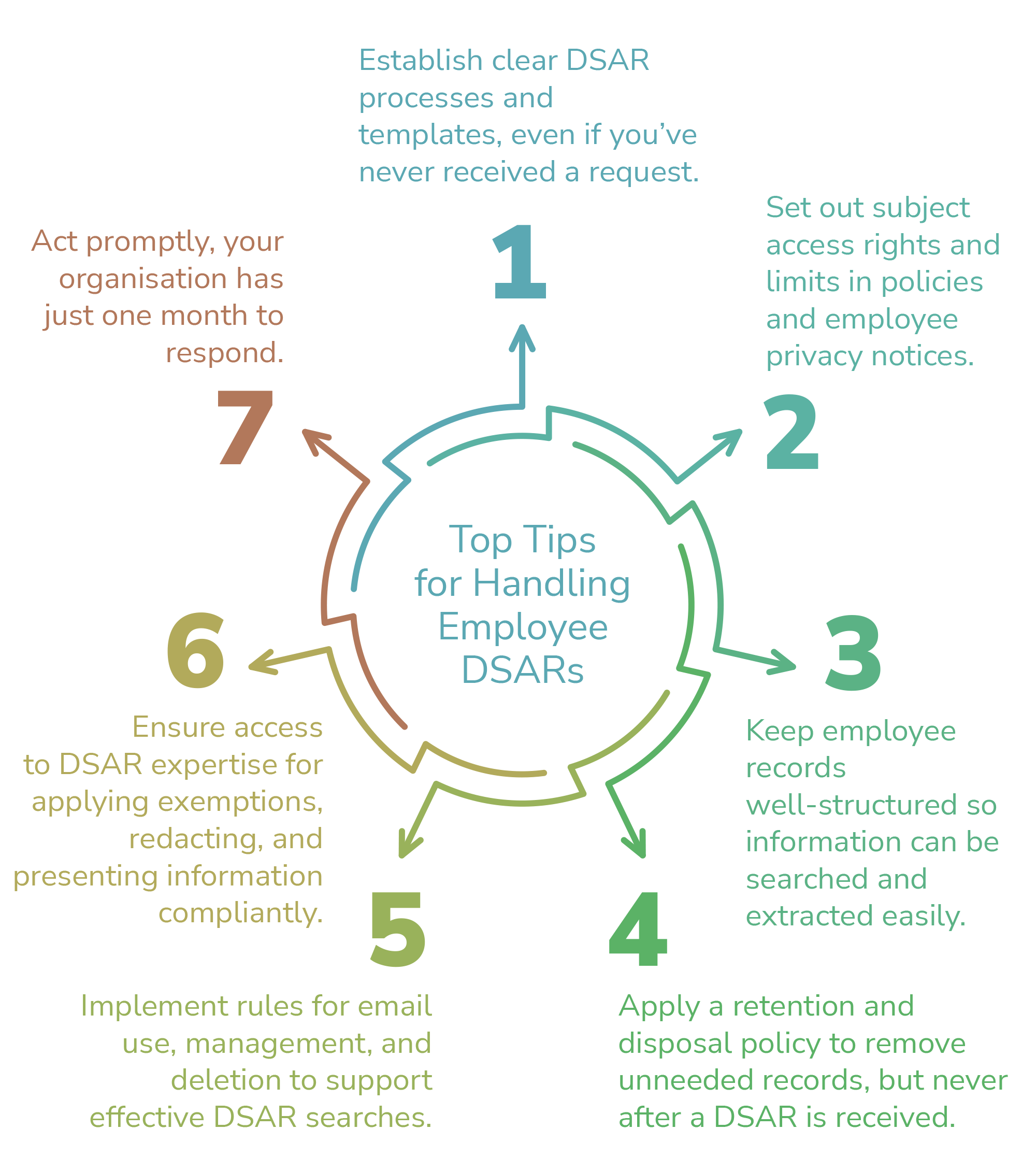
For now, UK employers won’t have to take a wider view on business emails and should follow the ICO guidance. Even in the UK, handing employee DSARs can be time consuming and costly if records are not well kept and staff are unprepared. For a detailed breakdown of DSARs and your obligations around them, read our blog on Everything You Need to Know About DSARs. However, below are a few top tips to help ensure your handling of employee DSARs is simple and compliant with the Regulation’s requirements:
If your organisation would benefit from assistance handling DSARs, or with any other aspect of GDPR compliance, URM is the ideal partner to provide this assistance. For help with DSARs, our highly qualified and experienced data protection team can offer a DSAR support service where we can manage the entire DSAR process. Once the raw data has been gathered, our GDPR consultants can sift through, remove duplicates, apply the necessary exemptions and redactions and package the DSAR for disclosure, all within the required timeframe.
In addition to our DSAR management and redaction services, URM can support any other aspect of data protection compliance that you require. For example, we can conduct a GDPR gap analysis of your current processing practices against the requirements of the Regulation, and provide a prioritised plan for remediating any issues we identify. In addition, we can offer more specific services, such as help conducting data privacy impact assessments (DPIAs) or producing a record of processing activities (ROPA). For ongoing support, we can provide a virtual data protection officer (DPO) service, which enables you to access an entire team of data protection experts, each with their own specialised area of GDPR consultancy.
URM regularly delivers a range of data protection-related training courses, each of which are led by an experienced data protection practitioner. If you would like to develop your team’s confidence and ability in their management of DSARs, URM delivers a 1-day ‘How to Manage DSARs’ training course which provides clear and practical instruction and guidance on dealing with all aspects of a DSAR. To learn how to conduct other key compliance activities, you can attend our half-day training courses on Conducting DTIAs and Conducting DPIAs. Meanwhile, if you would like to learn about the UK data protection landscape in general and gain an industry-recognised qualification, attend URM’s BCS Certificate in Data Protection (CDP) course, which will fully prepare you to sit and pass the BCS-invigilated examination.


We offer a free, no‑obligation call to help you understand your current data protection position and identify the most practical next steps
If you are unsure how GDPR applies to your organisation, we offer a free introductory call to help you understand risks, responsibilities, and practical next steps. There is no commitment, just clear, informed guidance.
We offer a free, no‑commitment call to help you understand your obligations, assess where you stand, and decide what action is proportionate for your organisation. Early clarity can save time, effort, and unnecessary compliance work.

URM’s blog discusses changes to the SCCs British organisations can use to legitimise restricted transfers of data under the UK GDPR

URM’s blog explores the different requirements introduced by these new laws, and the likelihood of a subsequent UK/EU adequacy decision for each nation.

URM’s blog breaks down the key data protection aspects to consider when sharing personal data with the police to ensure GDPR & Data Protection Act compliance.
